

(Part 1 of 6 in our Profit Leaks series for Canadian home-care agencies.)
More than 5,000 independent home-care agencies operate across Canada. Most are struggling to grow, and many are burning cash. In our four years running care services, we learned that profit doesn’t leak in one place. It leaks in six: intake, customer acquisition cost, pricing, labor, shift coverage and delivery efficiency. This is the first article in a six-part series, and it focuses on the leak that hurts agencies the most visibly and the fastest: slow intake response.
A family inquiring about home care is not browsing. Something has changed. A fall. A hospital discharge. A parent no longer safe alone. The call or the web form arrives in the middle of a difficult week, and the family is making a decision under pressure. If you don’t pick up, respond with empathy, and move them quickly to a next step, you have already lost them to a competitor.
What a Single Home-Care Inquiry Is Really Worth
Most home-care agency owners underestimate the dollar value of a single inquiry. The math is straightforward once you do it.
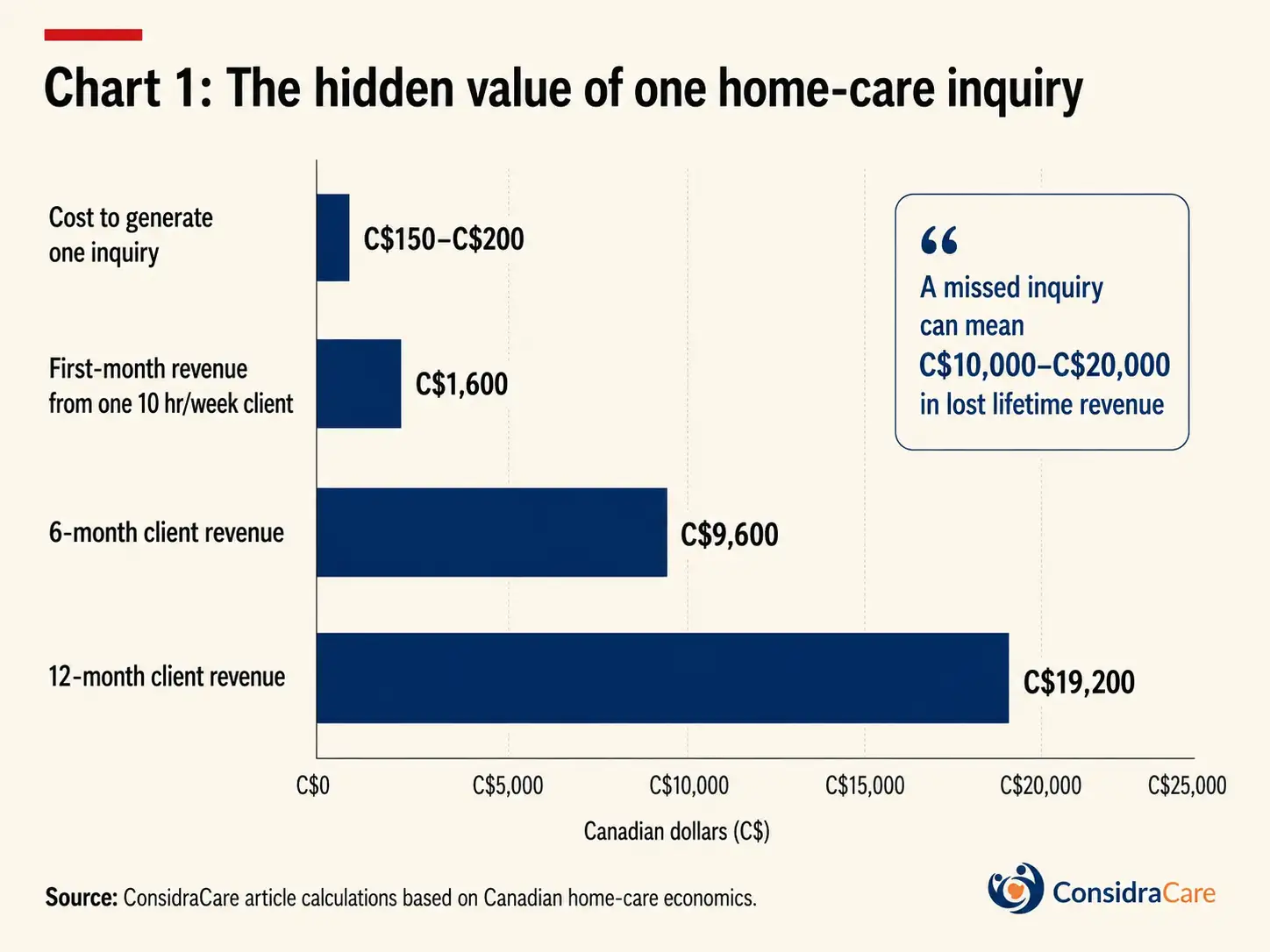
Home-care keywords on Google in Canada run roughly C$5 to C$7 per click, with the most competitive terms (such as “home care services,” “in-home care near me,” and city-specific searches) pushing toward C$10 in dense urban markets. Only a small share of clicks, typically 2 to 3 percent, convert to actual inquiries. That puts the cost of generating a single inquiry in the range of C$150 to C$200.
A single inquiry that converts to a 10-hour-per-week client at C$40 per hour is worth roughly C$1,600 in the first month alone. Most home-care clients stay much longer than a month. At an average tenure of 6 to 12 months, that one inquiry represents C$10,000 to C$20,000 in lifetime revenue. Long-tenure clients with higher care needs generate considerably more.
Every inquiry that goes unanswered is, in effect, between C$10,000 and C$20,000 in lost lifetime revenue. Agencies that miss two or three inquiries a week aren’t leaking a few hundred dollars per missed call. They are leaking the difference between a profitable year and a struggling one.
Why Home-Care Inquiries Are Not Like Other Web Leads
The standard marketing playbook for handling online leads does not translate cleanly to home care. Three characteristics of home-care inquiries change everything about how they need to be handled.
They are urgent. A family rarely calls a home-care agency to shop around. They call because something has happened that makes care necessary this week, often this day. The window for a decision is short.
They are emotional. The adult child making the call is usually exhausted, often anxious, sometimes grieving in advance. They are not in a buying frame of mind. They want to talk to someone who hears them.
They are shopping in parallel. By the time a family reaches your agency, they have probably already contacted two or three others. Your job is not to convince them that home care is the right answer. They already know. Your job is to be the agency that answers first, listens well and offers a clear next step.
These three traits are why the standard “respond within 24 hours” advice fails in home care. By 24 hours, the family has already chosen someone else.
What the Research Shows About Lead Response
Two findings from broader business and home-care research make the case for fast, systematic intake.
The Harvard Business Review studied response time for online leads across many industries. Companies that contacted a web lead within an hour were seven times more likely to qualify the lead than those that waited longer. After the first few minutes, contact rates dropped sharply. More than 30 percent of online leads were never contacted at all.
The 2023 Home Care Pulse Benchmarking Report, the largest survey of the home-care industry in North America, found that agencies that tracked every inquiry had more than double the median revenue of agencies that did not. Same industry, same year, similar service mix. The gap came down to what got followed up on and what fell through the cracks.
These two findings reinforce each other. Speed of response matters because the family decides quickly. Systematic tracking matters because what isn’t tracked doesn’t get followed up. Together they explain why intake separates the agencies that scale from the agencies that stall, regardless of marketing budget, service area or care quality.
How Home-Care Inquiries Get Lost
In our four years running care services, we watched agencies leak inquiries the same way over and over. The pattern is rarely a single dramatic failure. It is an accumulation of small ones, each easy to miss in the moment.
The owner is on a visit when the phone rings. Most independent home-care owners spend significant time in the field, doing assessments, covering shifts when caregivers cancel, building relationships with hospital discharge planners and physicians. The phone rings during one of those moments, and there is no good answer in real time.
The office staff who could answer don’t treat every call like a family about to choose someone else. They take a message. They promise a callback. They mean well. But “someone will get back to you” loses to “I can have a caregiver at your mother’s house tomorrow morning” every time.
The web form sits in an inbox until Monday. Many agency websites collect inquiries through a contact form that routes to a general email address. If the inquiry arrives Friday afternoon, no one sees it until the start of the next week. By then the family has already booked another agency.
Voicemail is a graveyard. Families in crisis rarely leave detailed voicemails. They hang up and call the next agency on the list.
After-hours inquiries vanish. Many of the highest-urgency calls come in evenings and weekends, when the family has finally had time to sit down and figure out what to do. Most agencies are not set up to handle these well, and the inquiry is gone by the time the office opens on Monday.
Side-door inquiries get lost entirely. A Facebook message, a LinkedIn note from a discharge planner, an email referral from a physician’s office. Each of these is real revenue, and most agencies have no consistent system for capturing them.
What Strong Intake Actually Looks Like
Strong intake isn’t a single tactic. It is a system that combines speed, empathy, capability and follow-up. The agencies that win do these things consistently.
They pick up by the third ring during business hours. The phone is the first line, and three rings is the maximum tolerance. Callers form their first impression in those few seconds.
They respond to web forms within the hour, ideally within minutes. The clock starts when the form is submitted, not when staff get around to checking the inbox.
They have after-hours coverage. Live answering services, on-call managers or automated callback systems handle inquiries when the office is closed. No inquiry sits unattended overnight.
They lead with empathy, then capability. The first thirty seconds of a call are about hearing the family. “Tell me what is going on” beats “What hours do you need” every time. The capability conversation comes second, once the family has felt heard.
They end every first call with a clear next step. After the first conversation, the family should know exactly what happens next: an assessment, a follow-up call, a meeting in the home, an introduction to a caregiver. No vague “we’ll be in touch.”
They track every inquiry in a system, not on paper. Even simple CRMs are enough to ensure no inquiry falls through. The point is to know, at the end of the week, how many inquiries came in, how many were responded to in time, how many converted to an assessment and how many became clients.
They follow up on inquiries that don’t immediately convert. A family may have called another agency first, found the experience unsatisfying, and be open to a second conversation a week later. Strong agencies have a defined follow-up cadence for unconverted inquiries.
How to Measure Your Own Intake Performance
Most agency owners can’t answer basic questions about their own intake, which is the first sign there is a leak. The questions worth being able to answer include:
How many inquiries did your agency receive last week, across all channels?
What was your average response time, in minutes, by channel?
What percentage of inquiries received a response within an hour?
What percentage of inquiries became assessments?
What percentage of assessments became admissions (active clients)?
If you can answer these five questions for the past month, you are ahead of most independent agencies in Canada. If you can’t, the gap between your operation and a strong operator’s is probably bigger than you realize.
Where Strong Operators Set the Bar
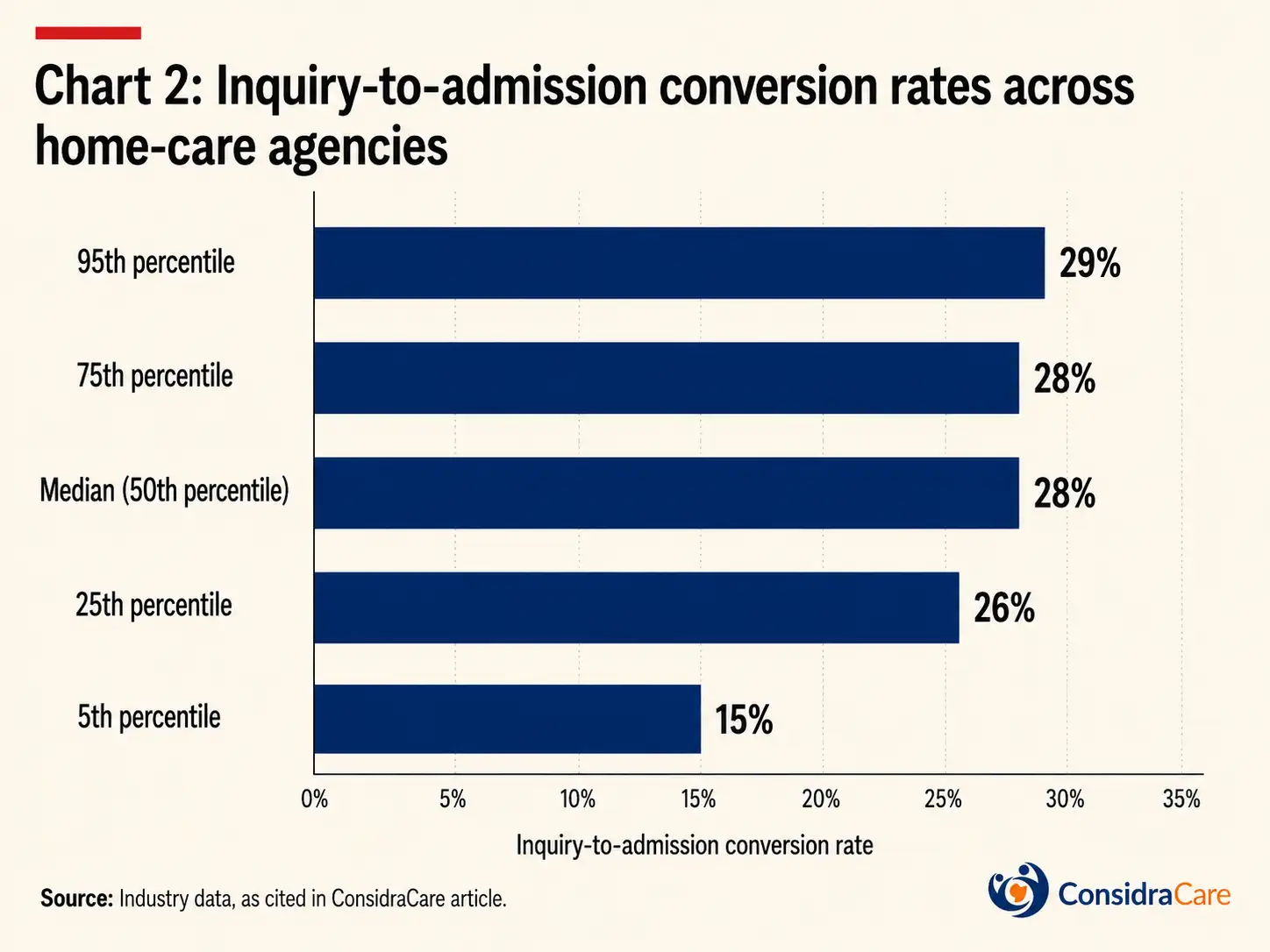
According to the 2023 Home Care Pulse Benchmarking Report, the median home-care agency in North America converts about 28 percent of inquiries to admissions. The 95th percentile sits at around 29 percent. The 5th percentile sits at 15 percent. The spread between the best and worst is roughly double.
Most of that spread is not driven by marketing or service quality. It is driven by how inquiries are handled in the first hour and the first week.
Strong operators respond to web forms within 15 minutes during business hours and within an hour after hours. They track every inquiry in a system. They keep inquiry-to-assessment conversion above 30 percent and inquiry-to-admission above 28 percent. They follow up on unconverted inquiries weekly for at least four weeks.
If your numbers are materially below these benchmarks, slow intake is almost certainly costing your agency more than any other single leak.
From Measurement to Action
Few agncy owners know their own numbers, and even fewer know how their numbers compare to the strongest operators in the industry. That gap is what our Care Agency Profitability Diagnostic is built to close.
The diagnostic is a free tool we built for Canadian home-care agency owners. It runs in your browser, takes about five to ten minutes and asks specific questions about your intake operations and the other five profit leaks. At the end you get a benchmarked score against strong operators, an identification of where your agency is leaking the most and a prioritized action plan.
A few things worth knowing about it.
The diagnostic is free, and no email is required to see your results. If you want the full report in your inbox, you can request it, and we won’t email you again unless you ask.
The questions are factual, not opinion-based. You are describing what your agency does, not rating yourself.
It is built on the same operational benchmarks consultants use, condensed into a self-serve tool. It is the kind of analysis a consultant would charge several thousand dollars for, except you get the answer instantly and it is based on your own numbers.
Coming Next in the Profit Leaks Series
This article covered the first of six profit leaks Canadian home-care agencies typically run in parallel. The other five each get their own deep dive.
Part 2: Customer Acquisition Cost. Most agencies don’t know what it costs them to acquire a new client. The article walks through how to calculate it accurately, what good looks like by referral source, and how to bring CAC down without sacrificing lead quality.
Part 3: Pricing Discipline. Home-care pricing is usually set once and rarely revisited. We will cover why published rates drift away from realized rates over time, how to spot the gap and how to close it without losing clients.
Part 4: Labor as a Percentage of Revenue. Strong operators run labor at 60 to 65 percent of revenue. Most agencies drift higher without realizing it. The article walks through how to find your real labor percentage and what to do if it has slipped.
Part 5: Shift Fill and Cancellation Coverage. Every shift that doesn’t get covered is a revenue hit. Every shift covered by overtime is a margin hit. We will cover the systems and behaviors that separate agencies running 98 percent fill rates from those stuck at 90 percent with frequent overtime.
Part 6: Delivery Efficiency. Assessments, onboarding, documentation and family communication can each be tightened materially without compromising care quality. The article shows where the time goes and how to get it back.
If you want to see how your agency scores on all six dimensions today, you don’t need to wait for the rest of the series. Take the diagnostic now, and read each article when it lands to go deeper on the leaks the diagnostic flags as your biggest.